
Warping a mosquito brain onto the fly by cross-identified neuropils
Source:vignettes/mosquito-to-fly.Rmd
mosquito-to-fly.RmdGoal
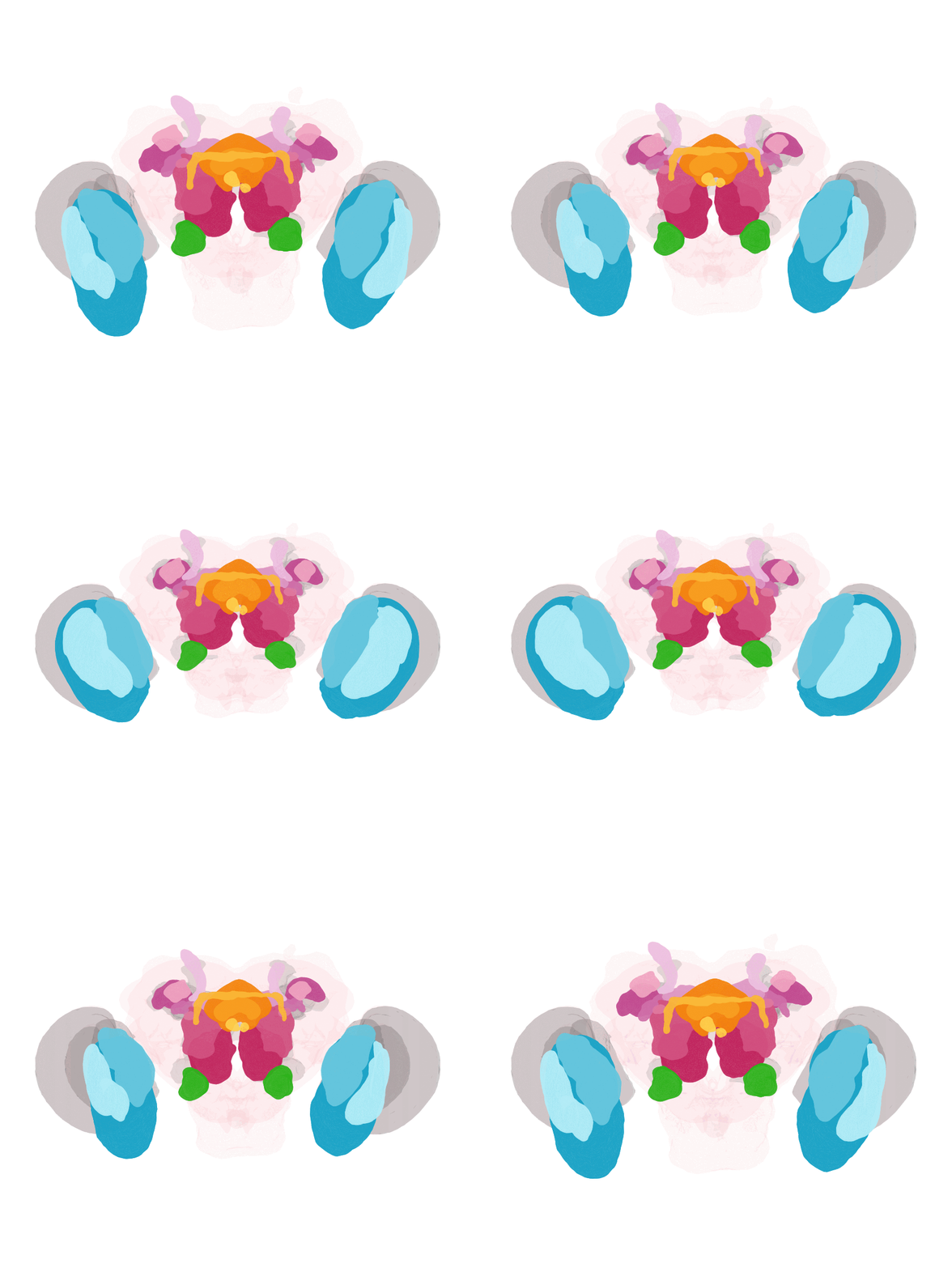
Register the whole-brain surface of the mosquito Aedes
aegypti onto the Drosophila JRC2018F
template — but driven by the cross-identified neuropils
the two brains share, matched left-to-left and
right-to-right so the warp respects the animals’ bilateral
symmetry. Everything below is plain R built from
deformetricar helpers.
The recipe is the one a good bridging registration uses:
- an affine pre-alignment to remove gross pose and
scale (
affine_prealign()), - a multi-object diffeomorphism
(
deformetrica_register_multi()) fit to the whole set of matched neuropils at once, each weighted, plus a weak outer hull, and - a nat.ggplot animation of the resulting geodesic
flow (
ggplot_flow_gif()).
library(deformetricar)
library(nat)
library(nat.flybrains)   # JRC2018F template + JFRC2NP neuropils
library(nat.jrcbrains)   # JFRC2 <-> JRC2018F bridging registration (for xform_brain below)
library(Rvcg)            # mesh decimation
# remotes::install_github("natverse/insectbrainr")
library(insectbrainr)    # Aedes brain from the Insect Brain Database

# One-time: set up the Deformetrica CLI this package wraps, in a managed conda env.
# (Skip if find_deformetrica() already resolves, e.g. options(deformetricar.exe=).)
# install_deformetrica()

# One-time: the JFRC2 -> JRC2018F step below needs the Saalfeld-lab bridging
# registrations (a few hundred MB). Loading nat.jrcbrains registers them; download
# them once with:
# nat.jrcbrains::download_saalfeldlab_registrations(filenames = "JRC2018F_JFRC2013.h5")
Everything below runs locally on a CPU — no GPU required.
device = "auto" uses a CUDA GPU if one is present and
transparently falls back to CPU (the whole-brain fit takes a few minutes
on a CPU, longer than on a GPU but perfectly usable).
1. The two brains and their neuropils
The fly side is the JRC2018F outer surface plus the standard
neuropils, brought into the JRC2018F frame once. The mosquito side is
the Aedes aegypti standard brain (an hxsurf of
named neuropil sub-surfaces) — a segmented atlas built by Meg
Younger’s lab and browsable at the Mosquito Brain Browser;
we load it here through the Insect Brain Database mirror. Please credit
that source when you use the Aedes brain.
fly     <- as.mesh3d(nat.flybrains::JRC2018F.surf)
fly_np  <- nat.flybrains::JFRC2NP.surf
xyzmatrix(fly_np) <- nat.templatebrains::xform_brain(
  xyzmatrix(fly_np), sample = "JFRC2", reference = "JRC2018F")

# Aedes has a FEMALE-only reconstruction in the Insect Brain Database.
aedes_brain <- insectbraindb_read_brain(species = "Aedes aegypti", brain.sex = "FEMALE")
2. Affine pre-alignment
A diffeomorphism should not absorb a cross-species change of pose and
scale — that is the affine step’s job. affine_prealign()
centres, isotropically scales and rigidly refines the mosquito onto the
fly, and hands back an apply() closure that replays the
identical transform on any sub-object, so every mosquito
neuropil is carried into the aligned frame consistently.
pre <- affine_prealign(as.mesh3d(aedes_brain), fly, type = "rigid")
# Keep only each neuropil's largest connected component: some Insect Brain Database
# surfaces carry a stray detached fragment that cannot warp onto the compact fly
# target and would poke out of the brain.
amesh <- function(region) pre$apply(Rvcg::vcgIsolated(as.mesh3d(subset(aedes_brain, region))))
fmesh <- function(region) as.mesh3d(subset(fly_np, region))
Drop the lamina from the deforming hull
The animation shows the whole aedes brain surface deforming onto the
fly. But one mosquito neuropil has no fly central-brain
counterpart at all: the lamina
(LA), the first optic ganglion. If we left it in
the hull it would be dragged onto empty fly space — visually wrong and a
waste of deformation. So we build the deforming hull from the aedes
brain minus its lamina regions, and it is this LA-free hull we
carry through every step below. (The affine map itself is untouched, so
every neuropil position is unchanged.)
3. Cross-identified neuropils, matched per side
Homologous neuropils have different names across taxa but
the same identity. We match each mosquito neuropil to its fly
counterpart one object per side, so the fit can never
swap a left structure onto a right one. The lamina (LA) has
no fly central-brain counterpart and is dropped.
# name = c(mosquito region regex, fly region); _L / _R kept as separate objects.
paired <- list(
  ME_L = c("^ME_LEFT","ME_L"),   ME_R = c("^ME_RIGHT","ME_R"),
  LO_L = c("^LO_LEFT","LO_L"),   LO_R = c("^LO_RIGHT","LO_R"),
  LOP_L= c("^LOP_LEFT","LOP_L"), LOP_R= c("^LOP_RIGHT","LOP_R"),
  CA_L = c("^CA_LEFT","MB_CA_L"),CA_R = c("^CA_RIGHT","MB_CA_R"),
  PED_L= c("^PED_LEFT","MB_PED_L"),PED_R=c("^PED_RIGHT","MB_PED_R"),
  ML_L = c("^ML_LEFT","MB_ML_L"),ML_R = c("^ML_RIGHT","MB_ML_R"),
  VL_L = c("^VL_LEFT","MB_VL_L"),VL_R = c("^VL_RIGHT","MB_VL_R"),
  AL_L = c("^AL_LEFT","AL_L"),   AL_R = c("^AL_RIGHT","AL_R"),
  AMMC_L=c("^AMMC_LEFT","AMMC_L"),AMMC_R=c("^AMMC_RIGHT","AMMC_R"),
  LAL_L= c("^LAL_LEFT","LAL_L"), LAL_R= c("^LAL_RIGHT","LAL_R"),
  GA_L = c("^GA_LEFT","GA_L"),   GA_R = c("^GA_RIGHT","GA_R"),
  AOTU_L=c("^AOTU-UU_LEFT","AOTU_L"),AOTU_R=c("^AOTU-UU_RIGHT","AOTU_R"))
first <- function(hx, pat) grep(pat, hx$RegionList, value = TRUE)[1]
srcs <- tgts <- list()
for (nm in names(paired)) {
  srcs[[nm]] <- amesh(first(aedes_brain, paired[[nm]][1]))
  tgts[[nm]] <- fmesh(paired[[nm]][2])
}
The central complex — a naming and a shape difference
Insect central-complex parts are named differently in mosquito and
fly, and one of them is a different shape. The mosquito
central body upper / lower divisions (CBU / CBL) are
the homologues of the fly fan-shaped body (FB) and
ellipsoid body (EB); the mosquito protocerebral bridge
(PB) and noduli (NO) match the fly PB and NO. Crucially the fly EB is a
closed ring, whereas the mosquito CBL is an open
arch — so forcing the whole shapes together distorts
the ring. We instead split each midline CX object into left and right
halves (split_mesh_lr()) and match per half, which keeps
the deformation symmetric.
mid_a <- mean(range(xyzmatrix(pre$aligned)[,1]))
mid_f <- mean(range(xyzmatrix(fly)[,1]))
cx <- list(FB = c("^FB/CBU","FB"), EB = c("^EB/CBL","EB"), PB = c("^PB_noside","PB"))
for (nm in names(cx)) {
  a <- split_mesh_lr(amesh(first(aedes_brain, cx[[nm]][1])), mid = mid_a)
  f <- split_mesh_lr(fmesh(cx[[nm]][2]), mid = mid_f)
  srcs[[paste0(nm,"_L")]] <- a$L; tgts[[paste0(nm,"_L")]] <- f$L
  srcs[[paste0(nm,"_R")]] <- a$R; tgts[[paste0(nm,"_R")]] <- f$R
}
# Noduli: mosquito NO is already L/R; the fly's single NO we split by its midline.
fno <- split_mesh_lr(fmesh("NO"), mid = mid_f)
srcs$NO_L <- amesh("^NO_LEFT");  tgts$NO_L <- fno$L
srcs$NO_R <- amesh("^NO_RIGHT"); tgts$NO_R <- fno$R
Splitting an unpaired object is itself a mini-registration. A midline object has no left/right label, but every point still belongs to a hemisphere.
mirror_lr_split()recovers that the way a mirroring registration does (cf.bancr::banc_lr): reflect the object, optionally warp it onto its own reflection to find the true (curved) symmetry surface, and label each point by how far and in which direction it must travel to meet its mirror partner.split_mesh_lr()above is the flat-plane special case.
Refine the affine on neuropil centroids
The whole-brain rigid affine of step 2 aligns the two hulls, but the mosquito’s internal neuropils still sit systematically ventral of their fly counterparts (here by ~26 µm in Y) — the brains pack their interiors differently. A diffeomorphism can absorb that, but a stiff, global kernel will drag small structures (galls, noduli, ellipsoid body) only part of the way. So we refine the init with a second similarity affine fit to the matched neuropil centroids, which removes the gross offset and lets the warp do local, not gross, work. We carry every source neuropil and the outer hull through the identical map so the whole template stays in one frame.
ctr    <- function(m) colMeans(xyzmatrix(m))
M      <- Morpho::computeTransform(t(sapply(tgts, ctr)), t(sapply(srcs, ctr)),
                                   type = "similarity")
applyM <- function(m) { xyzmatrix(m) <- Morpho::applyTransform(xyzmatrix(m), M); m }
srcs        <- lapply(srcs, applyM)
pre$aligned <- applyM(pre$aligned)   # the outer hull rides the same refinement
4. One diffeomorphism for the whole matched set
deformetrica_register_multi() fits a single
diffeomorphism to every matched object at once. data_sigma
weights each object — smaller means stronger — so we let the
well-matched neuropils drive the fit, damp the ring-vs-arch central
complex, and add the outer hull only as a weak global guide.
srcs <- lapply(srcs, Rvcg::vcgQEdecim, tarface = 4000L)
tgts <- lapply(tgts, Rvcg::vcgQEdecim, tarface = 4000L)
srcs$outer <- Rvcg::vcgQEdecim(pre$aligned, tarface = 12000L)
tgts$outer <- Rvcg::vcgQEdecim(fly,         tarface = 12000L)

# noise-std: SMALLER = stronger attachment. Neuropils strong; the outer hull is only
# a weak global guide; and — now the centroid refinement has removed the gross offset
# — the central complex is weighted PART BY PART to fix its specific shape mismatches:
# the ellipsoid body strongest (to circularise the open aedes CBL onto the fly ring),
# the fan-shaped and protocerebral bridges stronger (to match their curvature), and
# the galls strongest of all (to snap onto the small fly GA). (Tuned by iterating.)
sigma <- setNames(rep(3.0, length(srcs)), names(srcs))  # neuropils: strong
sigma["outer"] <- 4.0                                   # hull: weak global envelope (contains the MB lobes)
sigma[grep("^(VL|ML|PED)_", names(sigma))] <- 1.0       # MB lobes: strongest (compress the elongated vertical lobe)
sigma[grep("^EB_", names(sigma))] <- 1.5                # ellipsoid body: circularise the open arch onto the ring
sigma[grep("^(FB|PB)_", names(sigma))] <- 2.0           # fan-shaped body / protocerebral bridge: match curvature
sigma[grep("^GA_", names(sigma))] <- 0.5                # galls: strongest of all, snap onto the small fly GA
sigma[grep("^NO_", names(sigma))] <- 1.5                # noduli: land + resolve left/right
sigma[grep("^(ME|LO|LOP)_", names(sigma))] <- 1.5       # optic lobes: pull harder so all three hit their fly target

# Kernel width sets the deformation's spatial stiffness. Too large (~diagonal / 11)
# and it is so global that small peripheral structures (galls, noduli) get dragged by
# their big neighbours; a little smaller (~diagonal / 15) lets them deform locally onto
# their targets while the elongated optic lobes and MB lobes still move coherently
# (medulla surface error dropped from ~22 to ~4 um, noduli roughly halved). Set it from
# the target bounding box.
kw <- sqrt(sum((apply(xyzmatrix(fly), 2, max) - apply(xyzmatrix(fly), 2, min))^2)) / 15
fit <- deformetrica_register_multi(
  srcs, tgts, kernel_width = kw, data_sigma = sigma,
  timepoints = 15L, max_iterations = 60L, device = "auto")
5. Animate: first the affine, then the warp
We animate the registration in two acts so the
cross-species story reads. Act 1 shows the
affine — each structure appears in its native mosquito
proportions and settles into the initialised pose (the pre-alignment’s
scale and rotation). Act 2 is the warp —
deformetrica_shoot(..., flow = TRUE) returns every
timepoint of the geodesic flow, which ggplot_flow_gif()
renders with nat.ggplot, each neuropil in its own colour
over a translucent, unchanging fly brain.
show  <- setdiff(names(srcs), "outer")            # every cross-identified neuropil
# ACT 2 (the warp): shoot the neuropils AND the whole aedes brain hull, so the hull
# deforms too.
flows <- lapply(srcs[c("outer", show)], deformetrica_shoot,
                control_points = fit, device = "auto", flow = TRUE)   # `fit` is a deformetricareg

# ACT 1 (the affine): the pre-alignment's linear part (scale + rotation) maps native
# mosquito coordinates onto the fly; we replay it as motion — each structure revealed in
# its native mosquito proportions, then settling into the initialised pose. We apply that
# linear map CENTRED on the view (dropping the translation) so the fly and the camera
# stay put, then prepend this reveal to the warp.
Tp     <- function(P) Morpho::applyTransform(pre$apply(P), M)      # native pts -> aligned pts
o      <- Tp(matrix(0, 1, 3))
Lmat   <- rbind(Tp(matrix(c(1,0,0),1))-o, Tp(matrix(c(0,1,0),1))-o, Tp(matrix(c(0,0,1),1))-o)
Linv   <- solve(Lmat)
reveal <- function(keys, centre_keys, nf = 9) {
  cc <- colMeans(do.call(rbind, lapply(srcs[centre_keys], xyzmatrix)))
  setNames(lapply(keys, function(k) { av <- xyzmatrix(srcs[[k]])
    pv <- sweep(sweep(av, 2, cc) %*% t(Linv), 2, cc, "+")          # centred native proportions
    lapply(seq(0, 1, length.out = nf), function(a) { m <- srcs[[k]]; xyzmatrix(m) <- (1-a)*pv + a*av; m })
  }), keys)
}
a1     <- reveal(c("outer", show), show)                           # reveal centred on all neuropils
staged <- setNames(lapply(c("outer", show), function(k) c(a1[[k]], flows[[k]])), c("outer", show))
# Colour by functional group (L/R matched), shaded within group, LaCroix-inspired:
# optic = blue, mushroom body = pink-purple, central complex = yellow-orange, the SEZ
# AMMC green, and the rest of the mid brain cerise.
grp <- function(b) {
  if (b %in% c("ME","LO","LOP")) "optic"
  else if (b %in% c("AMMC")) "sez"
  else if (b %in% c("CA","PED","VL","ML")) "mb"
  else if (b %in% c("FB","EB","PB","NO")) "cx"
  else "midbrain"
}
grp_ramp <- list(optic=c("#1BA3C6","#B3ECF7"), sez=c("#2CB11B","#CBEFA0"),
                 mb=c("#C1478E","#EDBFE0"), cx=c("#F5850B","#FFD24D"),
                 midbrain=c("#C1275E","#F2A6C2"))
sb  <- sub("_[LR]$", "", show); groups <- vapply(sb, grp, character(1))
cols <- setNames(character(length(show)), show)
for (g in names(grp_ramp)) { gb <- unique(sb[groups == g]); if (!length(gb)) next
  ramp <- setNames(grDevices::colorRampPalette(grp_ramp[[g]])(length(gb)), gb)
  cols[groups == g] <- ramp[sb[groups == g]] }

# Fly context for the GIF: the whole brain hull as a very translucent light-pink
# envelope, and each matched fly *target* neuropil in a transparent greyscale, so the
# coloured mosquito neuropils can be read landing on their fly counterparts. The
# rotation flips Y to the canonical frontal view (dorsal up); the raw X-Y projection
# is upside down.
rmat <- diag(c(1, -1, 1, 1))
# The aedes hull is drawn first (behind), baby-pink + translucent so we watch it deform
# behind the coloured neuropils; a slow delay keeps the whole GIF ~5 s so the warp reads.
cols_all  <- c(list(outer = "#F7C6D0"), as.list(cols))
alpha_all <- c(outer = 0.08, setNames(rep(0.9, length(show)), show))
ggplot_flow_gif(staged[c("outer", show)], cols = cols_all, alpha = alpha_all,
                rotation_matrix = rmat, delay = 0.16,
                volume = fly, volume_col = "lightpink", volume_alpha = 0.08,
                targets = tgts[show], target_alpha = 0.18,
                file = "mosquito_to_fly.gif")   # needs the gifski (or magick) package
For a central-complex close-up (mosquito_cx_to_fly.gif),
animate just the
FB/EB/PB/NO (and the
gall GA) objects over the merged fly central complex — the
fly CX neuropils merged into one light-pink volume, each individual fly
CX target still drawn in transparent greyscale underneath.
cxn       <- grep("^(FB|EB|PB|NO|GA)_", show, value = TRUE)
cxvol     <- Rvcg::vcgClean(Morpho::mergeMeshes(unname(tgts[cxn])), sel = 0)  # merged fly CX
a1cx      <- reveal(cxn, cxn)                      # same two acts, reveal centred on the CX
staged_cx <- setNames(lapply(cxn, function(k) c(a1cx[[k]], flows[[k]])), cxn)
ggplot_flow_gif(staged_cx[cxn], cols = cols[cxn], rotation_matrix = rmat, delay = 0.16,
                volume = cxvol, volume_col = "lightpink", volume_alpha = 0.06,
                targets = tgts[cxn], target_alpha = 0.22,
                file = "mosquito_cx_to_fly.gif")
6. Validation — do the neuropils land on their counterparts?
The meaningful test is whether each warped mosquito neuropil lands on its fly homologue. Warp each and report the symmetric surface distance and a volumetric Dice overlap; the warp should beat the affine-only baseline for every neuropil.
surface_dist <- function(a, b) mean(Rvcg::vcgClostKD(a, b)$quality)
dice <- function(a, b) {
  ov <- Rvcg::vcgBool(a, b, "intersection")
  2 * Rvcg::vcgVolume(ov) / (Rvcg::vcgVolume(a) + Rvcg::vcgVolume(b))
}
score <- function(nm) {
  w <- nat::xform(srcs[[nm]], fit)                 # `fit` is a deformetricareg transform
  data.frame(neuropil = nm, affine = surface_dist(srcs[[nm]], tgts[[nm]]),
             warp = surface_dist(w, tgts[[nm]]), dice = dice(w, tgts[[nm]]))
}
do.call(rbind, lapply(names(srcs), score))
7. Package the whole bridge as one reusable transform (TPS)
Every aedes point of interest has now been carried into the fly template — through the affine pre-alignment, the centroid refinement, and the Deformetrica warp. We can fold all of that into one thin-plate-spline transform ([Morpho::tps3d()]), fit from a dense sample of native aedes positions to where each lands in fly space, and reuse it to bridge any new aedes object into the fly template in a single call — no Deformetrica needed at apply time.
# a dense sample of NATIVE aedes positions (the whole-brain surface vertices) ...
brain_native <- as.mesh3d(aedes_brain)
start <- xyzmatrix(brain_native)
# ... and where each lands after the FULL pipeline (affine -> centroid refine -> warp):
carried <- applyM(pre$apply(brain_native))                       # affine + centroid refine
end     <- xyzmatrix(nat::xform(carried, fit))                   # the Deformetrica warp

# One reusable mosquito -> fly bridge (affine AND warp), as a thin-plate spline:
mosquito_to_fly <- function(x) { xyzmatrix(x) <- Morpho::tps3d(xyzmatrix(x), start, end); x }
# e.g. bridge a fresh aedes neuron / mesh into JRC2018F:
# fly_space_obj <- mosquito_to_fly(some_native_aedes_object)
Because the TPS only needs start/end correspondences, the
earlier steps are free to be as elaborate as they like — for
example a separate affine per neuropil (each aligned to
its own fly counterpart) plus the hull, rather than one global affine,
which can tighten structures like the mushroom-body lobes. However the
internal warp is built, the final start -> end TPS still
captures the whole thing as a single, portable bridge.
Notes
- Central-complex nomenclature (CBU/CBL vs FB/EB, and the ring-vs-arch shape of the lower unit) follows the comparative insect central-complex literature; see the fly reference atlas (Hulse et al., eLife 2021) for the fly definitions.
- The lamina is excluded throughout — from the matched neuropils and from the deforming whole-brain hull — as it has no fly central-brain counterpart.
- Aedes brain credit. The Aedes aegypti standard brain is the segmented atlas from Meg Younger’s lab (Mosquito Brain Browser), here loaded via the Insect Brain Database. Please cite that source.
-
Tuning levers. Three parameters trade global
against local fit, per object:
data_sigma(attachment weight, smaller = stronger),object_kernel_width(the scale at which surface mismatch is measured, smaller = finer) and the globalkernel_width(deformation stiffness). The whole-brain error here is ~3–4 µm for almost every neuropil; a smallerkernel_width(~diagonal/15) was needed so small peripheral structures are not dragged by their large neighbours. -
The galls (GA) are a known hard case: tiny and
far-lateral, the single global diffeomorphism drags them off their fly
target no matter the weight, kernel width or object kernel. For a
structure like this, register it on its own with
deformetrica_register()rather than in the whole-brain fit. - Replace the whole-brain fit with a single homologous pair
(e.g. mosquito AL → fly AL) via
deformetrica_register()for a tighter, more local registration.